2026 · Gemma 4 · Flutter · Google LiteRT-LM
Catetin
Voice-first point-of-sale for small shops and vendors, powered by on-device Gemma 4 E2B. Track and analyze sales without hassle.
Catetin
Voice-first point-of-sale for small shops and vendors, powered by on-device Gemma 4 E2B. Track and analyze sales without hassle.
The Problem
Millions of families in Indonesia depend on "warungs": small kiosks, street-food carts, and corner shops that form the backbone of the country’s informal economy. Yet most of these businesses still operate without structured bookkeeping. Sales, stock levels, and profits are often tracked mentally or in handwritten notebooks while owners focus on serving customers. When records are incomplete or lost, the business has no reliable memory: owners cannot tell which products are most profitable, when inventory should be replenished, or whether performance is improving over time.
This challenge is widespread. A 2023 study found that 66% of Indonesian MSMEs do not record their daily buying and selling transactions, even though proper transaction records are critical for evaluating business performance and obtaining bank loans.
At the same time, digital solutions have failed to reach much of this market. Indonesia has more than 64 million MSMEs, but only around 17.5 million have integrated into the digital ecosystem. Traditional point-of-sale systems are often expensive, require stable internet connections, and assume comfort with technology; conditions that do not reflect the realities of small, informal local businesses.
The core problem is not the absence of bookkeeping technology, but the exclusion of the people who need it most. Existing tools demand typing, training, connectivity, and money before they deliver value. For a shop owner earning only a few dollars a day, these requirements become huge barriers.
The Solution — "Simply, Just talk."
Catetin replaces forms and bookkeeping with something every shop owner already knows how to do: Speaking
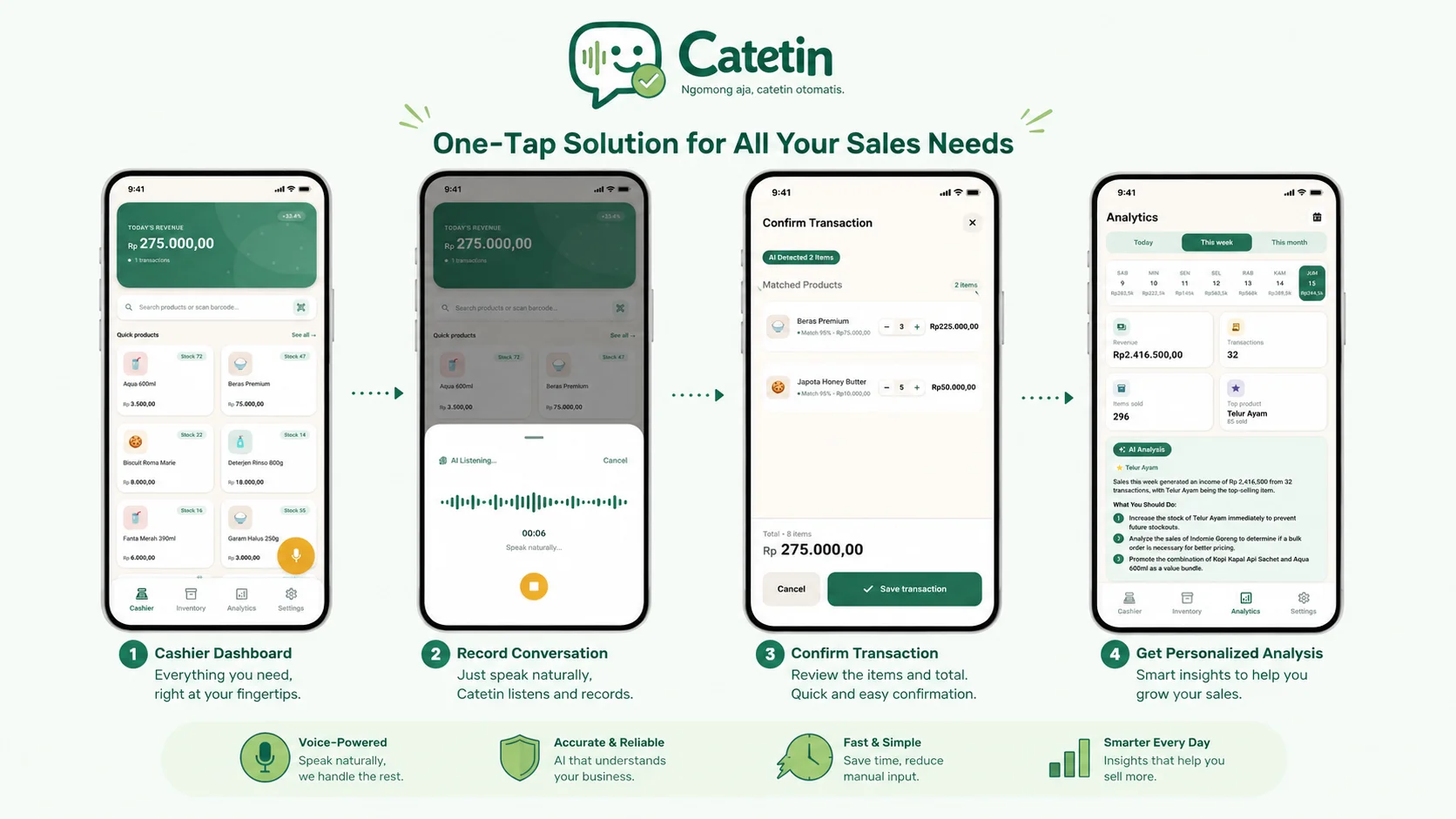
The owner taps one button and keeps serving the customer exactly as they always have. Catetin listens to the ordinary sales conversation — “Bu, dua Indomie sama satu Aqua dingin ya” (“Two packs of Indomie and one cold bottle of Aqua”) — and turns it into a structured, editable sales record: items matched to the catalog, quantities filled in, stock decremented, total computed. No keyboard. No training. No signal. All free of cost.
Beyond recording sales, Catetin helps owners understand their business in plain language. It can point out which products sell best, which items are running low, and what should be restocked next.
The value of Catetin is its simplicity: a shop owner who has never used accounting software does not need to learn a new system. They only need to do what they already do every day — talk, and the sale is recorded automatically.
Catetin was built to eliminate the three main barriers to adoption: it provides a structured digital ledger, runs at no additional cost on an existing phone, and requires nothing more than speaking naturally.
How We Use Gemma
Gemma 4 E2B is the core of Catetin. Rather than combining several separate AI tools, we use a single model running entirely on the device to handle the three tasks that make the product work.
- Turning Speech into Text
When the shop owner speaks during a transaction, Gemma 4 listens and converts the audio directly into text. We leverage the model’s native audio processing capability, which keeps Catetin simple and lightweight by using a single model for the entire workflow.
- Understanding What Was Sold
After converting the conversation into text, Gemma 4 matches the spoken order against the shop’s product catalog and identifies which items were purchased and in what quantities.
This is important because customers rarely say the full product name. A customer might say “one Chitato,” while the catalog lists “Chitato Roasted Beef 80gr.” Traditional keyword matching often fails in these cases because it relies on exact wording. Gemma 4 uses context to recognize that both refer to the same product, even when the name is abbreviated or the transcription contains minor errors.
When the model is not sufficiently confident, Catetin does not make the decision automatically. Instead, it asks the shop owner to choose the correct item, keeping the owner in control while reducing the need for manual input.
- Generating Business Insights
Gemma 4 also helps shop owners understand their business. Using summarized sales and inventory data, it produces simple recommendations such as:
- Which products are selling best
- Which items are running low
- What should be restocked soon
These insights are presented in plain language so that owners can act on them immediately.
- Fully Offline and Private
All of this runs directly on the user’s phone using LiteRT and Gemma 4 E2B. The model is stored on the device and uses available hardware acceleration when possible, while falling back to the CPU on less powerful phones.
Because processing happens locally, Catetin works without internet access and keeps both conversations and business data private.
Architecture & Engineering
Catetin is 100% Kotlin and Jetpack Compose, running natively on Android in a clean three-layer MVVM architecture (UI / domain / data) with an on-device database.
Catalog-grounded zero-shot extraction. Instead of transcribing freely and fuzzy-matching against the catalog, we inject the shop's product list into the prompt so the model maps spoken items to real inventory in one pass. We validated this on a 15-case suite across three dialects (Bahasa Indonesia, Javanese, Sundanese), each run clean and with realistic word corruptions. On the text extraction-and-matching stage, this reached 86% accuracy vs. 60% for the initial Jaccard approach.
LiteRT-LM as the inference backbone. The on-device model runs on LiteRT-LM, which is optimized for mobile and automatically adapts to the device — using the GPU where one is available and falling back to CPU where it isn't — so we get the best available performance without per-device tuning.
Segment-and-stitch for long conversations. The model has a ~30-second audio window, but real transactions run longer. We split recordings into overlapping segments that fit the window, transcribe each independently, then stitch them back into one continuous transcript by detecting and removing the words that overlap.
Privacy-first by design. Sales, items, and products live exclusively in an on-device database. The only data ever persisted beyond that is credentials, and only in hardware-backed, encrypted storage (AES-256-GCM). In local mode, nothing about the business ever leaves the phone.
The Hard Problem: Real-World Indonesian Speech
Where the real bottleneck is. We deliberately tested extraction separately from transcription because they fail for different reasons. The honest limitation today is the audio stage: the underlying speech model is not yet robust to the dialectal and accent diversity of Indonesian shops. Owners and customers use heavy slang, clipped abbreviations, and routinely mix proper Bahasa Indonesia with local languages, and that noise is now the dominant source of error. Gemma 4's out-of-the-box audio understanding degrades on this register, and there is no public dataset that captures this informal, code-mixed, transactional speech to adapt the model with. In the end, when transcription drifts, the in-context extraction inherits the error.
Future Work
Isolating the stages this way tells us exactly where to invest next: a transcription layer adapted to Indonesian regional speech, feeding an extraction stage we've already shown is strong. The clear next step is domain adaptation through fine-tuning: we plan to collect and label our own dataset of real sales conversations — slang, abbreviations, and local language code-mixing included — and fine-tune Gemma 4's audio path on it. This is exactly the domain-adaptation direction the challenge encourages, and it converts our weakest link into a defensible asset, since the dataset itself does not exist today.
Impact & Vision
Catetin brings the informal economy into digital bookkeeping at the lowest barrier physically possible: one button and your own voice. A reliable, owned sales ledger is the foundation for everything currently out of reach — credit access, demand forecasting, supplier coordination. Nothing here is Indonesia-specific: any low-resource market and any language Gemma understands can use the same offline, voice-first pattern. When the right tools are finally accessible to the people who were priced and typed out of them, the ledger writes itself.
Why the Name “Catetin”?
“Catetin” comes from the Indonesian word catat, which means “to write down” or “to record.” In everyday conversation, catetin means “just note it down.”
The name reflects the core idea of the product: shop owners do not need to type or fill out forms—they simply speak naturally, and Catetin records the transaction automatically.
Sources
Edwy, F. M., Firdaus, M. I., Febia, I., Leonardi, S., & Ramadhani, Z. A. (2023). Financial Management: The Implementation in MSMEs. International Journal of Multicultural and Multireligious Understanding, 10(10), 273–283. https://doi.org/10.18415/ijmmu.v10i10.5170
Coordinating Ministry for Economic Affairs of the Republic of Indonesia. (2022). Coordinating Minister Airlangga: Government continues to encourage strengthening economic foundations by establishing digital transformation of MSMEs as one of the priorities. https://ekon.go.id/publikasi/detail/4065/coordinating-minister-airlangga-government-continues-to-encourage-strengthening-economic-foundations-by-establishing-digital-transformation-of-msmes-as-one-of-the-priorities